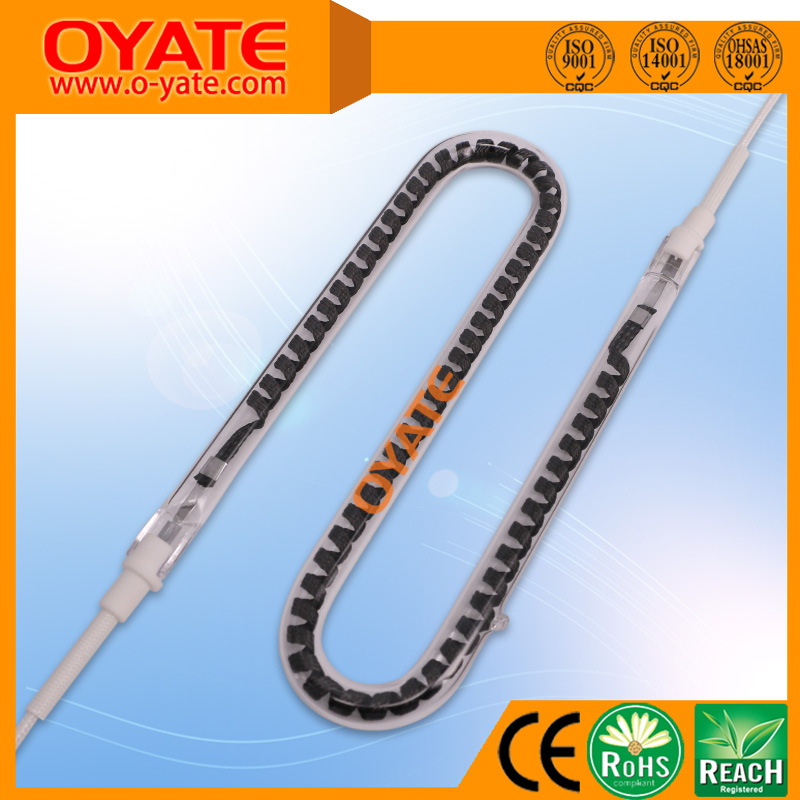
S shape half white coated 1300w 1800w carbon fiber infrared lamp
There are many advantages of using S-shaped carbon fiber heating tubes in printing dryers. The following is a detailed introduction:
Efficient heating performance
Fast heating: The S-shaped carbon fiber heating tube has an extremely fast heating speed. It usually takes only a few seconds to reach the working temperature and start to output a large amount of infrared heat. For example, in a small printing dryer, the use of S-shaped carbon fiber heating tubes can make the internal temperature of the dryer reach the required drying temperature within 5-10 minutes. Compared with traditional heating methods, it greatly shortens the preheating time and improves production efficiency.
High energy conversion efficiency: The heating tube has a high efficiency of converting electrical energy into infrared radiation energy, which can generally reach more than 90%, much higher than ordinary metal heating tubes. This means that most of the electrical energy can be effectively converted into heat for drying, reducing energy waste and energy costs, especially suitable for printing dryers that run continuously for a long time.
Uniform heating characteristics
Good temperature distribution: The infrared rays emitted by the S-shaped carbon fiber heating tube can form a relatively uniform temperature field in the printing dryer. Through reasonable layout and design, such as installing multiple groups of S-shaped heating tubes on the top, bottom and side of the dryer, the material can be evenly heated during the conveying process. When drying large-format printed fabrics, the temperature difference can be controlled within a small range, generally up to ±3℃-±5℃, effectively avoiding drying quality problems caused by local overheating or overcooling, such as uneven printing color, deformation of fabrics, etc.
Penetrating heating: Its infrared radiation has a certain penetrating ability and can penetrate deep into the interior of the dried material for heating. For printed materials with a certain thickness, such as multi-layer printed fabrics, thick cardboard, etc., this penetrating heating can ensure that the material is evenly dried from the inside to the outside. For example, when drying multi-layer printed fabrics, the infrared rays of the heating tube can penetrate the surface of the fabric, accelerate the evaporation of internal moisture, increase the drying speed, and ensure the quality of the printing and the stability of the color.
Precise temperature control
Sensitive temperature regulation: The S-shaped carbon fiber heating tube responds very sensitively to the temperature control system. During the temperature control process of the printing dryer, the temperature inside the machine can be accurately controlled by adjusting the power of the heating tube. With advanced temperature sensors and controllers, the temperature can be controlled within a very precise range to meet the temperature requirements of various printing materials and drying processes. For example, when drying high-end printed fabrics such as silk, the temperature control accuracy can reach ±1℃-±2℃, ensuring the stability of the drying process and product quality.
Fast temperature response: When the temperature of the printing dryer needs to be adjusted, the S-shaped carbon fiber heating tube can respond quickly. In some cases where the temperature needs to be dynamically adjusted according to the characteristics of the printed material or the drying progress, such as requiring a high temperature to quickly remove a large amount of moisture in the early stage of drying, and then lowering the temperature in the later stage of drying to avoid changes in the printed color, the S-shaped carbon fiber heating tube can quickly respond to these temperature change requirements and improve the flexibility of the drying process.
Adapt to a variety of printing materials and drying processes
Applicability of various materials: The S-shaped carbon fiber heating tube can be applied to the drying of various different types of printing materials, including but not limited to textiles, paper, leather, plastic film, etc. Whether it is printed fabrics made of natural or synthetic fibers, or paper of different weights and textures, they can be effectively dried under its infrared radiation without damaging the printed pattern and the material itself.
Flexible drying process support: It can support a variety of drying processes, such as continuous drying, intermittent drying, high-temperature fast drying, low-temperature slow drying, etc. By adjusting the power of the heating tube, the conveying speed of the dryer, the ventilation volume and other parameters, different drying process requirements can be achieved. In practical applications, the drying process can be flexibly selected and adjusted according to factors such as the nature of the printing material, the moisture content, and the quality requirements after printing to meet diverse production needs.