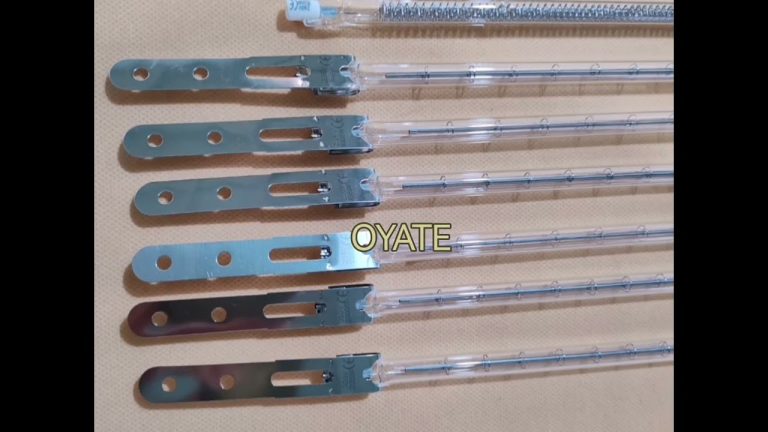
Near – infrared (NIR) Wavelengths (780 – 1400 nm)
Heating Mechanism: Near – infrared radiation is absorbed very close to the surface of the object. The energy of NIR photons is quickly converted into heat at the surface layer.
Heating Efficiency in Specific Applications:
Advantages: In applications where rapid surface heating is desired, NIR lamps are highly efficient. For example, in the printing industry, when drying ink on paper, NIR heat lamps can quickly evaporate the solvent in the ink. The heat is concentrated on the ink layer, and the short wavelength allows for a fast response. The ink dries almost instantly as the surface temperature rises rapidly due to the absorption of NIR radiation.
Limitations: However, NIR radiation does not penetrate deeply. So, if the goal is to heat an object throughout its volume, NIR lamps alone may not be sufficient. For instance, if you want to heat a thick block of wood to a certain internal temperature, NIR lamps will mainly heat the surface, and the heat will take a long time to conduct to the interior.
Mid – infrared (MIR) Wavelengths (1400 – 3000 nm)
Heating Mechanism: MIR radiation can penetrate a bit deeper than NIR into the object. The absorption of MIR photons occurs in a slightly thicker layer of the material.
Heating Efficiency in Specific Applications:
Advantages: In the food – processing industry, when drying fruits or nuts, MIR heat lamps are more effective than NIR lamps. The MIR radiation can penetrate the outer layers of the food and heat the moisture inside, leading to more efficient drying. It can reach the water molecules within the food structure and cause them to evaporate. This is because the absorption characteristics of water and organic materials in the mid – infrared range allow for better energy transfer to the water content for drying.
Limitations: Although MIR radiation penetrates deeper than NIR, it still may not provide uniform heating for very thick or highly heat – resistant materials. For example, in heating a large, thick metal casting, the MIR radiation may not be able to heat the center of the casting as efficiently as the outer layers.
Far – infrared (FIR) Wavelengths (3000 nm – 1 mm)
Heating Mechanism: FIR radiation has the ability to penetrate deeply into objects and heat them more evenly from the inside out. It interacts with the molecular vibrations of the material, causing the entire volume of the object to heat up.
Heating Efficiency in Specific Applications:
Advantages: In applications such as far – infrared saunas, the FIR heat lamps are very efficient. The human body is mostly composed of water, and FIR radiation can penetrate the skin and heat the body tissues and fluids. This deep – penetrating heat promotes sweating and relaxation. In industrial applications, for heating large, bulky materials like concrete blocks during a curing process, FIR lamps can ensure that the heat reaches the interior of the block, leading to more uniform curing and better structural integrity.
Limitations: FIR lamps may heat up more slowly compared to NIR lamps when only surface heating is required. For example, if you want to quickly set a thin layer of glue on a surface, FIR lamps may not be as efficient as NIR lamps because their energy is more focused on heating the entire volume rather than just the surface.