

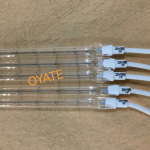


Infrared halogen lamps are a type of high-efficiency heating source. They are composed of a tungsten filament enclosed in a quartz tube and activated by a high-power supply. These lamps belong to the halogen lamp series, with a wavelength range of 0.76 to 5 micrometers and a peak wavelength of 4 micrometers, emitting short and medium-wave infrared radiation.
The advantages of infrared halogen lamps include: high efficiency, fast heat transfer, quick response to control devices, compact structure, and light weight. The filament is supported by tungsten to prevent sagging, and the lighting position can be horizontal or at any desired position.
There are different types of infrared radiation heating sources, such as:
– Short-wave: With high power and strong penetration, it has a considerable power output, capable of concentrating radiation on the target to provide efficient heat energy. Due to its ability to reach full working intensity within a few seconds, short-wave radiation heating sources are very suitable for processes that require rapid start and stop.
– Fast medium-wave: Stable, efficient, and with quick on-off response.
– Medium-wave: Efficient and economical. It can quickly heat the surface and thin layers of objects, and has the feature of being rapidly absorbed by a water film. Compared to short-wave radiators, medium-wave is particularly suitable for the drying process.
The application scope of infrared halogen lamps is extensive. They can be used for heating, drying, evaporation, softening, hardening, molding, activation, lamination, disinfection, baking, and other processing of materials such as rubber, plastic, glass, printed circuit boards, vehicle bodies, metals, castings, leather, food, etc. They can also be used for curing various powder coatings, water-based coatings, primers, top coatings, paints and dyes, printing inks, films, glazes, pastes, adhesives, and binders.
When choosing an infrared halogen lamp, factors such as wavelength, power, and specific application requirements should be considered to ensure it meets the needs of the intended use. Additionally, safety precautions should be followed during installation and operation to ensure proper and safe usage.
\\u00a0


