

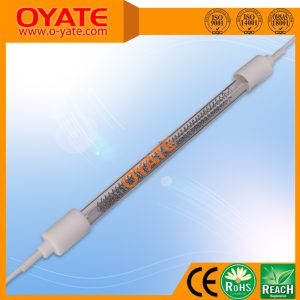
620mm 850w lampara de infrarrojos quartz halogen heat lamp quartz paint drying lamp
Here’s how you can determine the appropriate wavelength of an infrared heat lamp for a specific application:
\\u00a0
1. Consider the Material and its Absorption Properties
\\u00a0
- Different materials have different absorption spectra for infrared radiation. For example, water has strong absorption bands in the mid – and far – infrared regions. If you are drying a material that contains a significant amount of water, such as food products (fruits, vegetables, etc.) or textiles, mid – to far – infrared wavelengths (around 1400 nm – 1 mm) would be more effective. The water molecules in the material will absorb this radiation, and the energy is converted into heat, which aids in the drying process.
- In contrast, some plastics and polymers may have better absorption in the near – infrared range (780 – 1400 nm). When heat – treating or shaping plastics, near – infrared heat lamps can provide the necessary heat input by being absorbed at the surface of the material and quickly raising its temperature.
\\u00a0
2. Depth of Penetration Required
\\u00a0
- If you need to heat only the surface of an object, near – infrared wavelengths are the way to go. They are absorbed quickly at the surface and do not penetrate deeply. This is ideal for applications like surface – drying of paints or coatings. For instance, in a printing press, near – infrared lamps can be used to dry the ink on the printed paper quickly without affecting the paper structure beneath the ink layer.
- When a more uniform or deeper heating effect is needed, mid – and far – infrared wavelengths are more suitable. In the case of heat – treating metal parts to relieve internal stresses, far – infrared radiation can penetrate the metal to a certain depth and heat the interior as well as the surface, ensuring a more consistent temperature throughout the part.
\\u00a0
3. The Nature of the Process
\\u00a0
- For processes that require rapid heating and short – term exposure, near – infrared can be a good choice. For example, in a fast – paced manufacturing line where small plastic components need to be softened quickly for molding or assembly, near – infrared heat lamps can provide the necessary heat in a short amount of time.
- For slower, more controlled heating processes such as annealing of glass or slow – drying of delicate herbal products, far – infrared wavelengths are often preferred. The gentle, deep – penetrating heat of far – infrared radiation can help in achieving a more even and less – damaging heating process.
\\u00a0
4. Temperature Sensitivity of the Object
\\u00a0
- Some objects or substances are sensitive to high – temperature gradients. For example, in biological samples or certain electronics components, a sudden high – temperature change on the surface can cause damage. In such cases, far – infrared heat lamps with their more even heating characteristics are a better option. The slow and even heat penetration can help in gradually raising the temperature of the object without creating a large temperature difference between the surface and the interior.


